The head of the Moscow office of imperial theatres and theatrical schools, Nikolay von Bool and the Rukavishnikov dynasty of sculptors in studio no. 36.
1900s-1910s
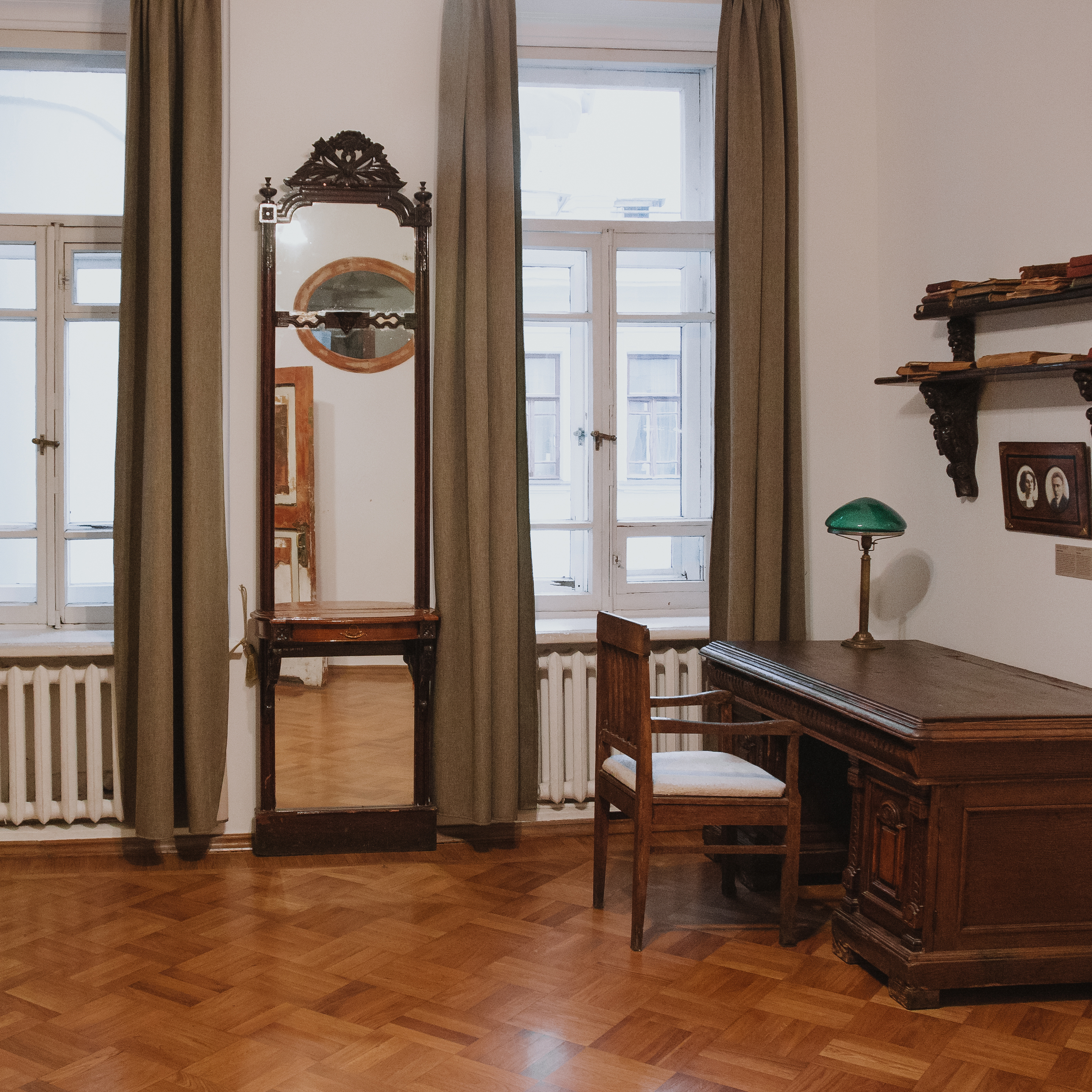
The central part of the building which faces the yard was (and remains partially) occupied by art studios. Before the Revolution, the studio on the second floor was rented by the artist and administrative clerk, Nikolay von Bool (1860-1938). In 1903 Nikolay von Bool was appointed head of the Moscow office of imperial theatres and theatre schools. Nikolay Konstantinovich held this position until 1910. In his memoirs, the director of imperial theatres, Vladimir Telyakovsky, characterised von Bool as a ‘real civil servant, with all the good and bad qualities associated with the word’ (V. Telyakovsky, Memoirs, Leningrad, 1965). He probably resigned by 1910 to concentrate on art. Living with his wife Yulia Grigorevna and daughter Olga on Arbat, he rented the studio on Bolshaya Sadovaya for his artistic endeavours. Nikolay Konstantinovich mainly drew Crimean landscapes and views of St. Petersburg and Moscow. In her memoirs, Natalia Petrovna Konchalovskaya, daughter of the artist Petr Konchalovsky, who lived in studio no. 40 with her family, wrote: “A director of the Bolshoi Theatre by the name of von Bool occupied the studio under the Yakulovs. He was a portly, surly man with a puffy face framed by grizzled sideburns. I remember he was always wrapped in a scarf, in a fur cap and tall boots” (N. Konchalovskaya, Magic and Hard Work, Moscow, 2004).
1920s-1930s
Due to the ambiguous ownership status of the art studios in the building, the housing committee took the artists to court on numerous occasions. Nikolay von Bool did not escape this fate, being registered in apartment no. 35 and renting the art studio for his work. It all began on 9 April 1924 when the special commission of the Council of People’s Commissars for dealing with overcrowding resolved to appropriate surplus living space from von Bool, i.e. the art studio. The house administration wanted to resettle von Bool, take the art studio and move print workers there from the basement. However, on 27 August, a letter arrived from the Moscow Property Administration ordering a halt to the settlement of new residents in the studio since it was subject to appropriation for the city and the housing association had no right to it. The housing administration sent another letter to the Moscow Property Administration on 8 September, requesting that the studio remain under the control of the housing committee of house no. 10, but they were refused and told to take the matter to court. The case became drawn out. The conclusion of this story is unclear, but obviously N.K. von Bool and the housing committee managed to hang on to the space. It retained its status as a studio and was not settled with workers. In 1937, Mitrofan Sergeevich Rukavishnikov (1887-1946) received the studio in apartment no. 36. Mitrofan Sergeevich was born in Nizhny Novgorod and moved to Moscow in 1919. In the 1920-1930s, the sculptor produced decorative sculptures as well as frescoes, decoration, and set designs for shows in the Jewish Theatre and for ballet shows on ice. In 1930-1940s Rukavishnikov was commissioned to produce a series of decorative architectural compositions for Moscow: “Capital”—a marble fountain in the Hermitage garden, “Muse with a Tambourine”—a sculptural work on the façade of the Bolshoi Theatre and “Angels”—a relief on the pediment. Mitrofan Sergeevich’s family lived on Granatny Lane, but the premises on Bolshaya Sadovaya were used exclusively as a studio.
1940s-1970s
In the late 1940s, the studio was passed to Mitrofan Sergeevich’s son Iulian Mitrofanovich Rukavishnikov (1922-2000). Iulian Mitrofanovich’s most significant works include the monument to A.P. Chekhov in Taganrog, a series of statues of Lenin, busts of I.P. Pavlov, I.V. Kurchatov, N.A. Ostrovsky and M.V. Lomonosov. Iulian Mitrofanovich worked alongside his wife the sculptor Angelina Nikolaevna Filippova (1923-1986) in the studio. In the late 1960s, Iulian Rukavishnikov’s son, the sculptor Aleksandr Iulianovich Rukavishnikov (born 1950), began to work in the studio. At that time, his father received a studio near Novy Arbat. Aleksandr Rukavishnikov often visited his parents’ studio as a child: “I remember I was taken to the studio when I was little. I knocked over sculptures a couple of times. The first time, I knocked over a four-metre sculpture. The second time, I almost dropped it, but I held on to it for a long time, and it was considered a great achievement that I was able to hold on to it for so long. I think it was mum’s statue of Kuybyshev”.
1980s-1990s
Aleksandr Iulianovich is one of Moscow’s greatest contemporary sculptors. Some of his most famous works among Muscovites include monuments to M. Sholokhov on Gogolevsky Bulvar, F. Dostoevsky by the Russian State Library, Alexander II by the Church of Christ the Saviour, Y. Nikulin on Tsvetnoy Bulvar, V. Rostropovich and M. Magomaev near Bryusov and Eliseevsky lanes, and Sergey Mikhalkov on Povarskaya Street.
2000s-2010s
Aleksandr Rukavishnikov’s son, Filipp Rukavishnikov (born 1974) now works in the studio. His works includes the “Teapots” cycle of sculptures (1990-2003), the collaboration between Aleksandr and Filipp Rukavishnikov on the monument to V.V. Nabokov (Montreux, Switzerland, 1999), the sculptures “Butterfly on a Leaf” and “Snails” (Moscow, Kurkino, 2006), the “Inspiration” fountain by the Tretyakov Gallery, the bust of F.M. Dostoevsky for the Russian embassy in Lima (Peru, 2007) and others.