

The famous architect Lev Kekushev built this miniature castle in the Art Nouveau style in 1903 for his wife. Situated two steps away from the Master’s basement and decorated with a multi-faceted turret, this house is considered one of the most likely sources of inspiration for Margarita’s house. From 1935 to 1986, Ostozhenka was known as Metrostroevskaya Street.
‘Margarita Nikolaevna and her husband occupied the entire upper floor of a beautiful house in a garden in one of the lanes near Arbat. It’s a lovely place! Anyone can see it for himself, if he cares to visit the garden. Ask me, I’ll tell you the address and show you the way — the house still stands to this day.’ The gothic style of the building and the mention of the fact that the heroine’s bedroom was in the tower of the house show that 21 Ostozhenka could have been a model for Margarita’s house. The story which occurred within the walls of this ‘castle’ is also interesting: Ekaterina Kekusheva, the daughter of the architect, defied the protests of her family and left the rich household for the Maly Theatre set designer, Sergey Topleninov. Ekaterina and Sergey frequently visited 9 Mansurovsky Lane to see Topleninov’s older brother (this house is believed to be one of the models for ‘the Master’s house’). However, house 21 is located slightly further away from Arbat and there is no garden or fence nearby as described in The Master and Margarita, which allows the search for new addresses for Margarita’s house to continue…
Point on the map
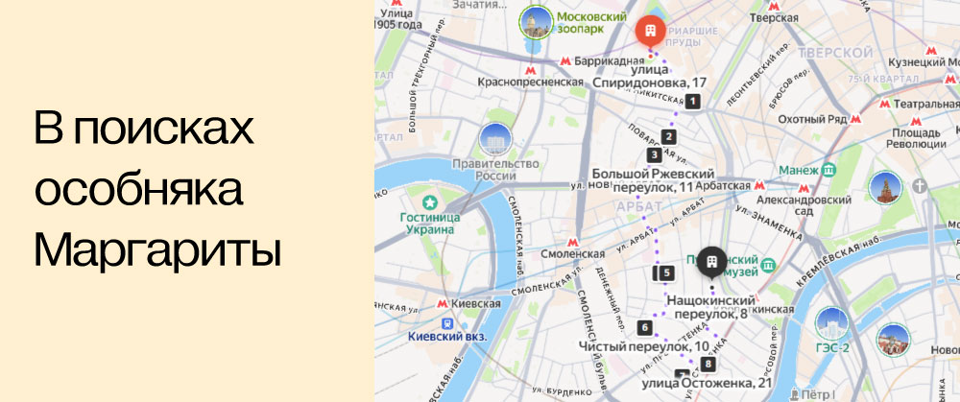
This map shows where the address sits and how it is tied into the project routes.
Routes
This point belongs to one or more routes. Open them as sequential walks rather than isolated cards.
In the footsteps of the characters of The Master and Margarita
- Stop 15
- 5,52 km
- 4,5 h
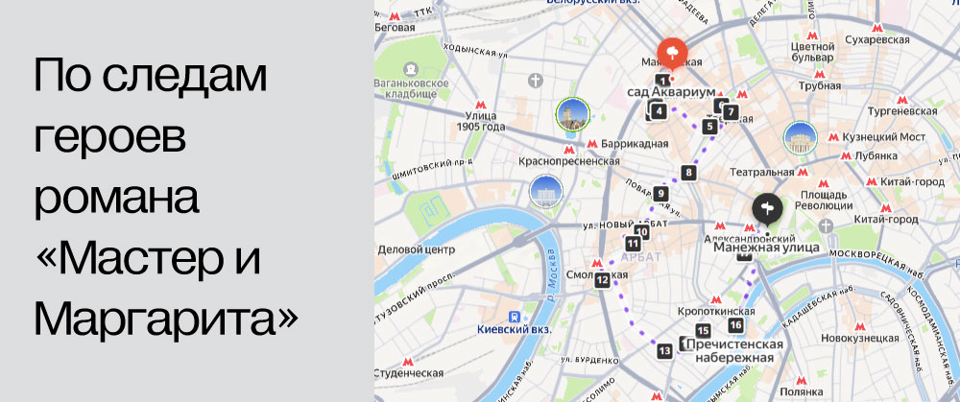
Daily life in Moscow in the 1920s and 1930s plays an important role in the multi-layered novel, The Master and Margarita — it is not simply a background for the fantastical events and the characters’ unusual adventures. The novel, addressed to Bulgakov’s contemporaries, describes the lives of Muscovites in detail, with the arguments arising in communal flats, the issue of flats, the spy scare, the invisible but tangible atmosphere of the Great Terror and so on. The events of the novel take over the entire centre of Moscow, and Bulgakov was almost always very precise in the details – the exceptions include only a few addresses (Margarita’s house, the Dramlit house, Stravinsky’s clinic etc.). Bulgakov’s contemporaries would easily recognize their city in the other details, had the novel been printed at that time. Since then, the city has changed a lot – some houses have been demolished, some have been rebuilt unrecognizably, but through the layers, it is possible to glimpse Bulgakov’s Moscow. Following in the footsteps of Bulgakov’s characters, you can feel Ivan Bezdomny’s horror after the death of Berlioz at Patriarch’s Ponds, his desperation in Herzen’s house, the scale of Satan’s ball in Spaso House, the eccentricity of Behemoth’s antics in the Torgsin on Arbat, and much more. The route begins at the Aquarium Garden, not far from Woland’s ‘unpleasant flat’, runs across Tverskoy Boulevard, takes in the lanes around Arbat and ends at the Alexandrovsky Garden, where Azazello and Margarita met.
Margarita’s houses
- Stop 9
- 5,6 km
- 1,30 h
In the novel The Master and Margarita, Bulgakov accurately depicts 1920s-1930s Moscow with all her side streets, squares, houses and gardens. Even now, after dozens of years, it is possible to take the book in one’s hands and walk around practically all of the significant places in the novel. However, a number of important addresses have remained a mystery to this day. One of these is the house that inspired the house in which Margarita lived before meeting the Master – it has still not been found. In the novel, ‘Margarita Nikolaevna and her husband occupied the entire upper floor of a beautiful house in a garden on one of the lanes near Arbat’. We also know that it was a gothic house. It seems simple – follow the free and independent Margarita’s movements and spot the right house. However, it turns out that in that very lane there is and never was a gothic house. \tIn our route guide, we have gathered all the possible addresses, which could have served as the basis for the house in the novel: the Military house in which E.S. Shilovskaya lived with her husband; Solovyev’s house five minutes’ walk from Elena Sergeevna’s house; K.F. Lazarev’s block of flats not far from Mikhail Bulgakov’s final flat; and others. You can walk around each of them and choose the one which you think is the most likely to have been Margarita’s.
Around Prichestenka
- Stop 10
- 5 km
- 1 h
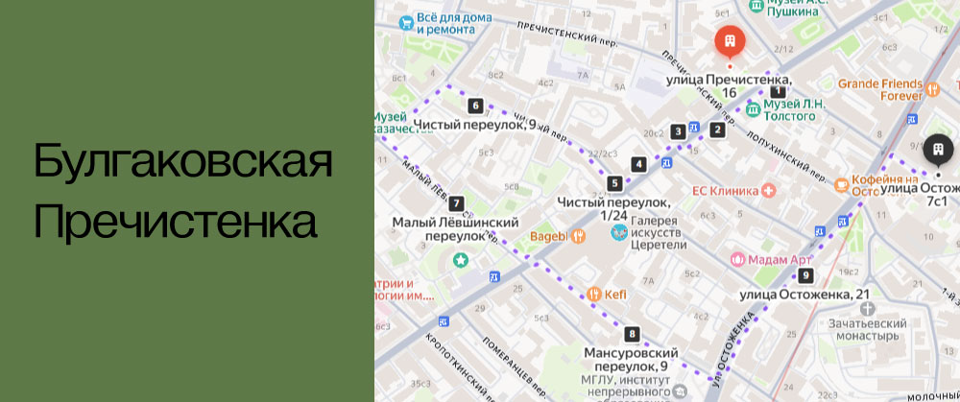
In November 1924, Bulgakov moved away from Bolshaya Sadovaya, and, moving a number of times, lived on Obukhovy (Chisty) Lane, and Maly Levshinsky, until he finally moved to Bolshoy Pirogovskaya Street in 1927. He lived here until 1934 and then moved with his third wife to the first flat he occupied without neighbors, which was also his last, on Nashchokinsky Lane. The writer spent the late 1920s on Prichestenka and the little roads leading onto it – his Muscovite friends N. Lyamin, S. Zayaitsky, S. Shervinsky and others lived here. It was a circle of highly educated, old Muscovite intellectuals, who did not accept the provincial Bulgakov immediately. N. Lyamin, the writer’s close friend, lived on Pozharsky Street. Nearby was the State Academy of Arts, where many of the writer’s friends worked, and Mansurovsky Lane, where S. Topleninov lived, whose house served as inspiration for the Master’s basement.\t \tThe events of the short novel Heart of a Dog (1925) take place around Prechistenka. Bulgakov’s uncle, N.M. Pokrovsky’s, house was on the corner of Prechistenka and Obukhov (Chisty) Lane – it was he who inspired the almost omnipotent Professor Preobrazhensky with his seven-roomed apartment. With this route guide in your hands, you can go into the smallest details and bring this ‘monstrous story’ to life: find the backstreet where Sharik was picked up, discover the shop in which Preobrazhensky bought the Krakow sausage, and much more. The route finishes at Novodevichy Cemetery, where M. Bulgakov is buried.