

The garden was built around the Kremlin after the 1812 Fire of Moscow on the orders of Emperor Alexander I. The original name of the garden was the Kremlevsky Garden — the name was changed to the Alexandrovsky Garden in 1856. In The Master and Margarita, the meeting between Margarita and Azazello at which he invites the heroine to meet, ‘a completely safe foreigner’ takes place in the Alexansrovsky Garden. This is where Margarita receives the magical lotion as a gift.
The Alexandrovsky Garden and its surroundings also appear in Bulgakov’s essays. In May 1923, he witnessed a demonstration against the British Lord Curzon: ‘On Okhotny Ryad, endless rows of people walked along spanning the breadth of the street. I saw how Teatralnaya Square was completely flooded with people…’ (Benefit Performance for Lord Curzon), and in January 1924, he described the thousands of workers who gave to pay their respects to Vladimir Lenin. In the essay, Forty Forties, a commercial Moscow was presented: ‘On Okhotny Ryad the signs are so large that they overbear the little shops’. Korobochka, the heroine of Bulgakov’s satirical piece, The Adventures of Chichikov, planned to open a bakery in the Moscow Manège: ‘In vain they tried to convince her that the Manège is a public building and that it can’t be bought and that you can’t open anything inside it. The stupid wench didn’t understand a thing.’ The meeting between Margarita and Azazello in Alexandrovsky Garden is the last scene that the dying Bulgakov managed to adjust. Elena Bulgakova remembered: ‘In 1940, he made some more additions to the first part. However, when we moved onto the second part, I began to read about Berlioz’s funeral. He was about to begin making corrections when he suddenly said, -“Ok, I think that’s enough”, and he didn’t ask me to read anymore.’ The editing of the novel ended on Margarita’s words, ‘So then those are litterateurs following the coffin? ’
Point on the map
This map shows where the address sits and how it is tied into the project routes.
Routes
This point belongs to one or more routes. Open them as sequential walks rather than isolated cards.
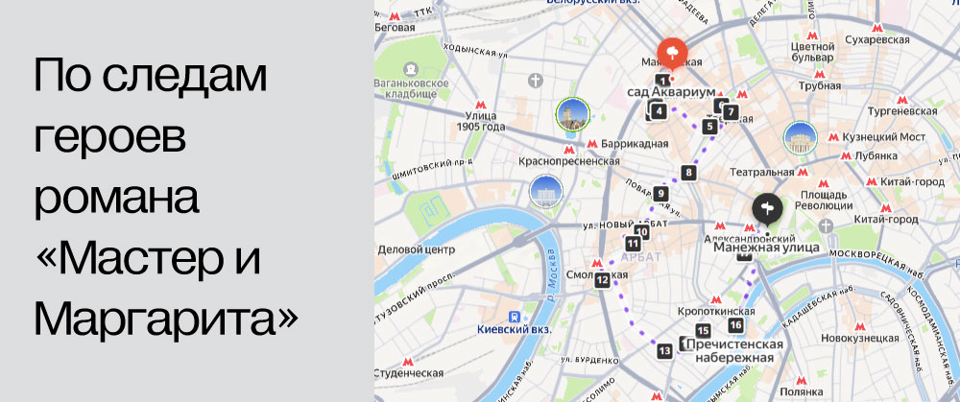
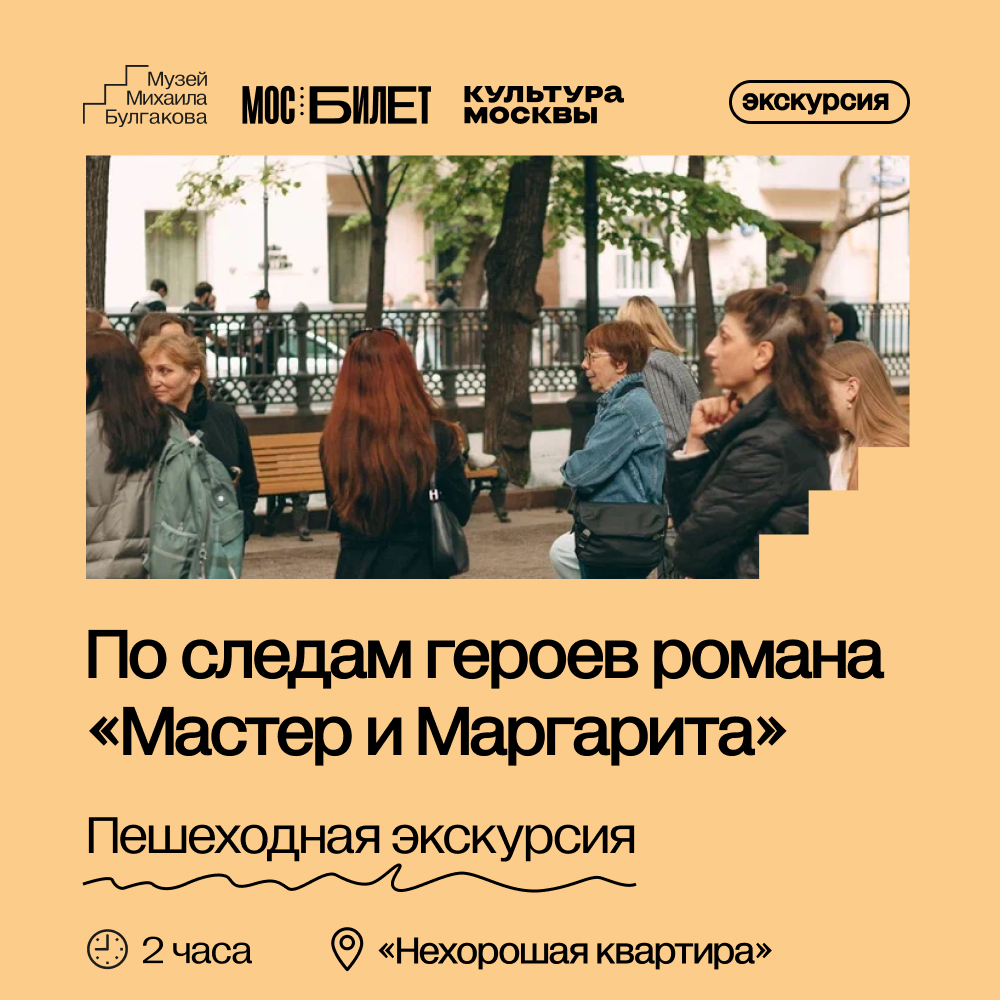
In the footsteps of the characters of The Master and Margarita
- Stop 20
- 5,52 km
- 4,5 h
Daily life in Moscow in the 1920s and 1930s plays an important role in the multi-layered novel, The Master and Margarita — it is not simply a background for the fantastical events and the characters’ unusual adventures. The novel, addressed to Bulgakov’s contemporaries, describes the lives of Muscovites in detail, with the arguments arising in communal flats, the issue of flats, the spy scare, the invisible but tangible atmosphere of the Great Terror and so on. The events of the novel take over the entire centre of Moscow, and Bulgakov was almost always very precise in the details – the exceptions include only a few addresses (Margarita’s house, the Dramlit house, Stravinsky’s clinic etc.). Bulgakov’s contemporaries would easily recognize their city in the other details, had the novel been printed at that time. Since then, the city has changed a lot – some houses have been demolished, some have been rebuilt unrecognizably, but through the layers, it is possible to glimpse Bulgakov’s Moscow. Following in the footsteps of Bulgakov’s characters, you can feel Ivan Bezdomny’s horror after the death of Berlioz at Patriarch’s Ponds, his desperation in Herzen’s house, the scale of Satan’s ball in Spaso House, the eccentricity of Behemoth’s antics in the Torgsin on Arbat, and much more. The route begins at the Aquarium Garden, not far from Woland’s ‘unpleasant flat’, runs across Tverskoy Boulevard, takes in the lanes around Arbat and ends at the Alexandrovsky Garden, where Azazello and Margarita met.