
This is the supposed place of MASSOLIT Chairman Mikhail Berlioz’s death in The Master and Margarita: ‘And right then a tram came hurtling along, turning down the newly-laid line from Ermolaevsky to Bronnaya. The tram went over Berlioz and a dark, round object was thrown out under the fence of Patriarch’s Path onto the cobbled slope. It was the severed head of Berlioz.’
“Are you looking for the turnstile, citizen?” inquired the checked type in a cracked tenor. ‘Come this way!” The precise location of the fateful turnstile remains a mystery for fans of the novel to this day. Having decided to contact the bureau of foreigners, Berlioz headed for the telephone booth on the corner of Ermolaevsky Lane and Malaya Bronnaya Street. By the time the literary man was approaching the turnstile, the tram had already turned and was moving along Bronnaya — so the turnstile was not on the corner but somewhere close further along the street. The location of the tramlines at Patriarch’s Ponds remains to be explained. We know that there was no passenger tram line here, although in numerous publications about Bulgakov and his works there is information about a temporary freight line and about an unofficial depot used to regulate the traffic on the main lines.
Point on the map
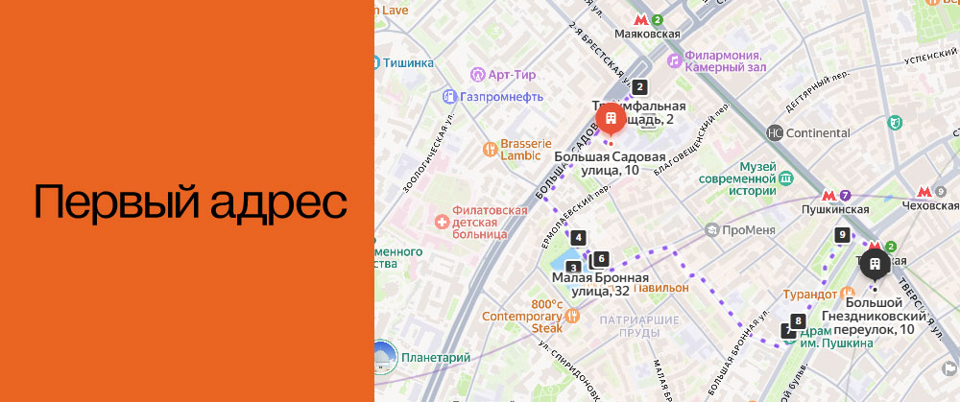
This map shows where the address sits and how it is tied into the project routes.
Routes
This point belongs to one or more routes. Open them as sequential walks rather than isolated cards.
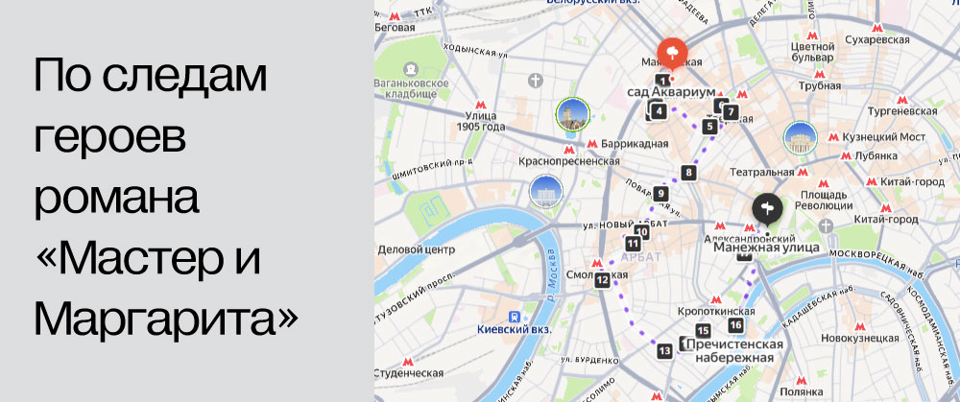
In the footsteps of the characters of The Master and Margarita
- Stop 4
- 5,52 km
- 4,5 h
Daily life in Moscow in the 1920s and 1930s plays an important role in the multi-layered novel, The Master and Margarita — it is not simply a background for the fantastical events and the characters’ unusual adventures. The novel, addressed to Bulgakov’s contemporaries, describes the lives of Muscovites in detail, with the arguments arising in communal flats, the issue of flats, the spy scare, the invisible but tangible atmosphere of the Great Terror and so on. The events of the novel take over the entire centre of Moscow, and Bulgakov was almost always very precise in the details – the exceptions include only a few addresses (Margarita’s house, the Dramlit house, Stravinsky’s clinic etc.). Bulgakov’s contemporaries would easily recognize their city in the other details, had the novel been printed at that time. Since then, the city has changed a lot – some houses have been demolished, some have been rebuilt unrecognizably, but through the layers, it is possible to glimpse Bulgakov’s Moscow. Following in the footsteps of Bulgakov’s characters, you can feel Ivan Bezdomny’s horror after the death of Berlioz at Patriarch’s Ponds, his desperation in Herzen’s house, the scale of Satan’s ball in Spaso House, the eccentricity of Behemoth’s antics in the Torgsin on Arbat, and much more. The route begins at the Aquarium Garden, not far from Woland’s ‘unpleasant flat’, runs across Tverskoy Boulevard, takes in the lanes around Arbat and ends at the Alexandrovsky Garden, where Azazello and Margarita met.
First address
- Stop 5
- 2,1 km
- 1 h
The route encompasses sites of literary and biographical significance in the life of Bulgakov, centred around the environs of Patriarch’s Ponds. \tAt the end of September 1921, Bulgakov arrived in Moscow with the intention of becoming a writer – his first address was flat 50 in house 10 on Bolshaya Sadovaya Street. Bulgakov’s first three years in Moscow were closely connected with the region around the Patriarch’s Ponds. The Patriarch’s Ponds are not only important in Bulgakov’s biography, but also in his works – this is where the events of The Master and Margarita begin. In the novel, Woland and his retinue live on Bolshaya Sadovaya, the characters in the tale The Spiritual Séance inhabit 32 Malaya Bronnaya, and so on.