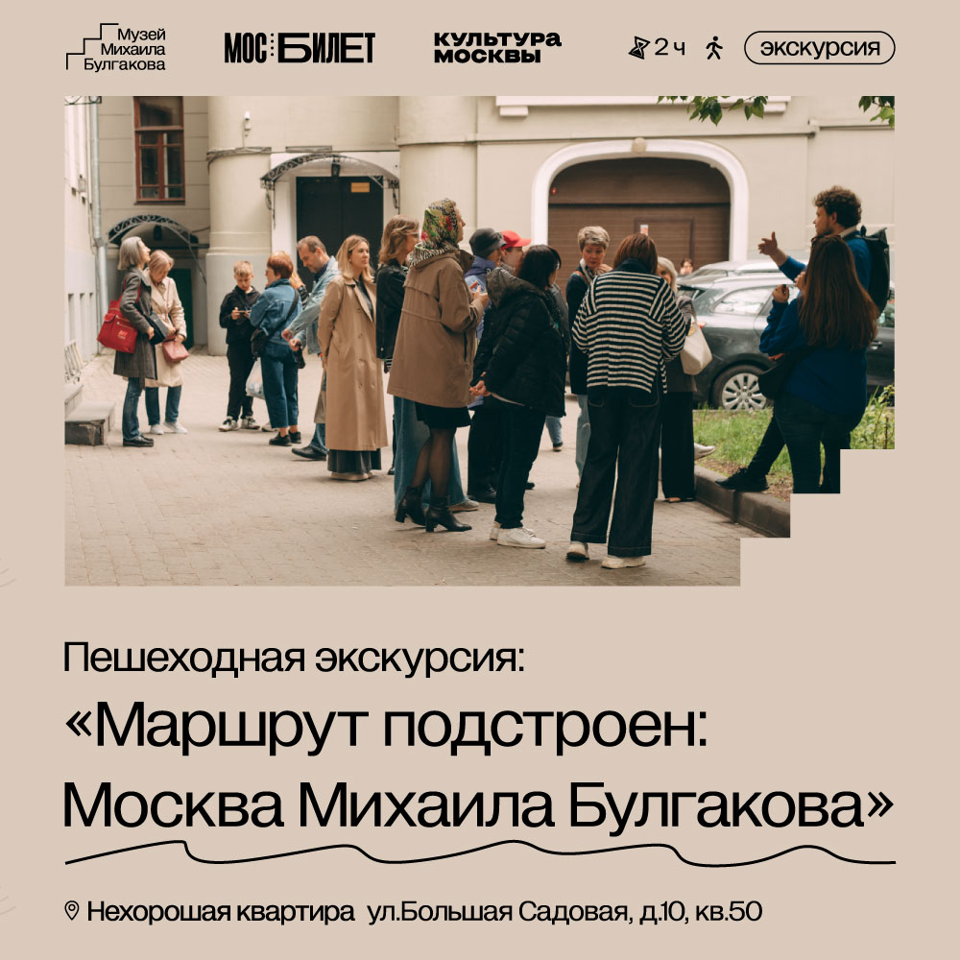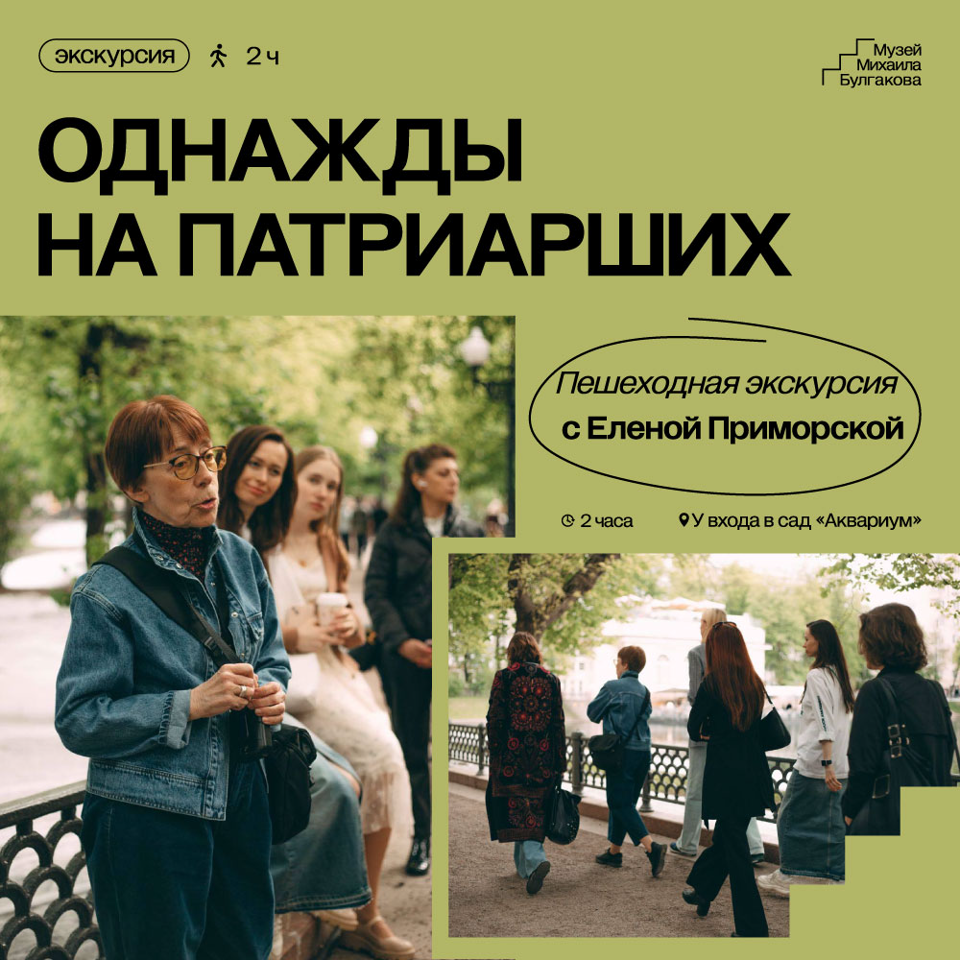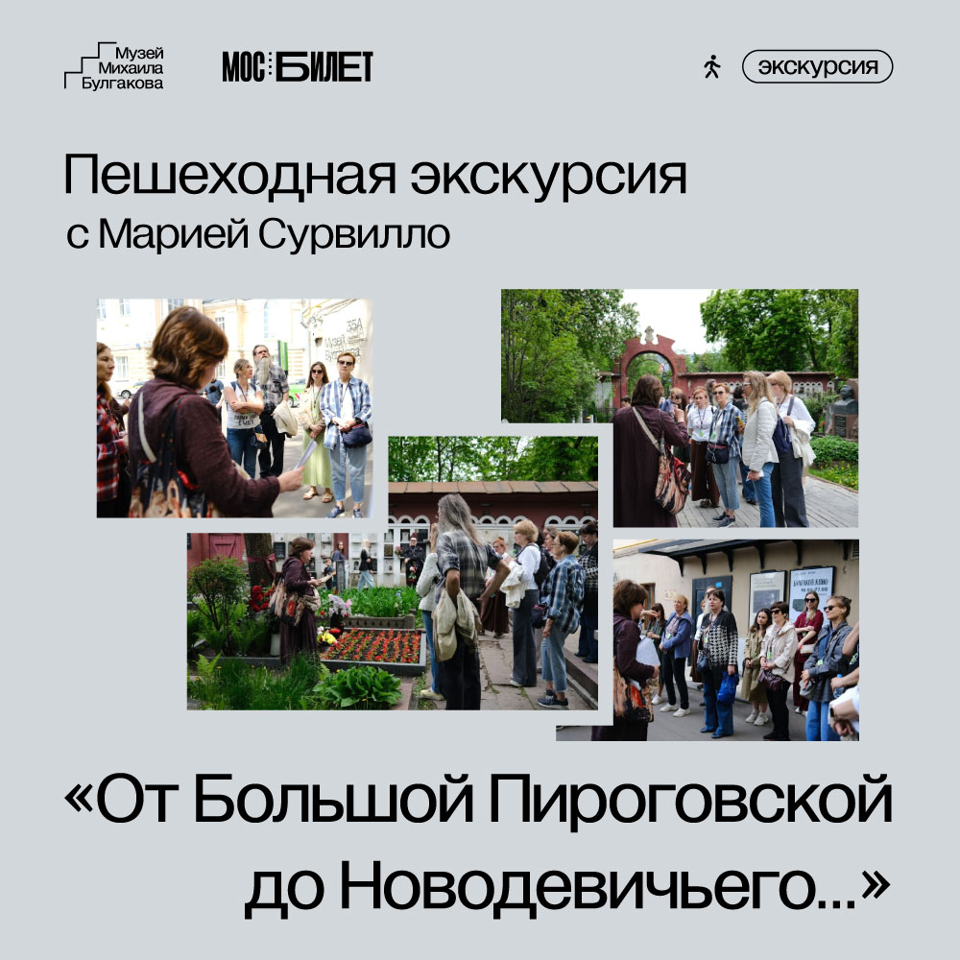


Daily life in Moscow in the 1920s and 1930s plays an important role in the multi-layered novel, The Master and Margarita — it is not simply a background for the fantastical events and the characters’ unusual adventures. The novel, addressed to Bulgakov’s contemporaries, describes the lives of Muscovites in detail, with the arguments arising in communal flats, the issue of flats, the spy scare, the invisible but tangible atmosphere of the Great Terror and so on. The events of the novel take over the entire centre of Moscow, and Bulgakov was almost always very precise in the details — the exceptions include only a few addresses (Margarita’s house, the Dramlit house, Stravinsky’s clinic etc.). Bulgakov’s contemporaries would easily recognize their city in the other details, had the novel been printed at that time. Since then, the city has changed a lot — some houses have been demolished, some have been rebuilt unrecognizably, but through the layers, it is possible to glimpse Bulgakov’s Moscow. Following in the footsteps of Bulgakov’s characters, you can feel Ivan Bezdomny’s horror after the death of Berlioz at Patriarch’s Ponds, his desperation in Herzen’s house, the scale of Satan’s ball in Spaso House, the eccentricity of Behemoth’s antics in the Torgsin on Arbat, and much more. The route begins at the Aquarium Garden, not far from Woland’s ‘unpleasant flat’, runs across Tverskoy Boulevard, takes in the lanes around Arbat and ends at the Alexandrovsky Garden, where Azazello and Margarita met.
Route map
The route is shown on a dedicated map so you can see the full walk and jump straight to any stop.
Route stops
Open the stops in order: each page keeps its own address, context, and link back to the route.
From 1911, the Nikitin brothers’ circus was based in the Garden, which was mentioned in the short novel Heart of a Dog – it was here that Dr. Bormenthal took Sharik. In 1926-1936 the Moscow Music Hall was located in the Garden (the building has not survived and the Theatre of Satire stands in its place). The Aquarium Garden and Music Hall probably provided inspiration for the Summer Garden and Variety Theatre in The Master and Margarita. It was there that Woland put on the famous black magic show. Bulgakov saw the Aquarium Garden every day through the kitchen window of the communal flat in house 10 on Bolshaya Sadovaya. In the 1890s, the first Moscow electrical exhibition opened on the site of the future garden and shortly after, the owner of the garden, S. Malkiel, rented it out to entrepreneurs (M. Lentovsky, F. Tomas and others), one of whom was Charles Aumont, and in 1898, the garden was named the ‘Aquarium Garden’. Entertaining and cultural events were often held here and visitors could go up in a hot-air balloon, visit a photographer’s studio, an ice rink, a shooting range, a bowling alley and also the opera and theatre. The Garden is mentioned numerous times in Bulgakov’s works. In The Fatal Eggs, ‘In the Aquarium Garden, ablaze with neon advertisements and shining, half-naked women, the writer Lenivtsev’s revue Sons of Chickens was being played to great applause amongst the greenery of the open-air stage.’ In The Master and Margarita, Ivan Varenukha encountered Woland’s retinue in the lavatories in the Garden. The Garden is even mentioned in some of Bulgakov’s journalism (Chanson d’été and Travels in Crimea).
Mikhail Bulgakov Museum
10 Bolshaya Sadovaya Street, flat 50
- Mayakovskaya
- Bulgakov's personal addresses
- Prose
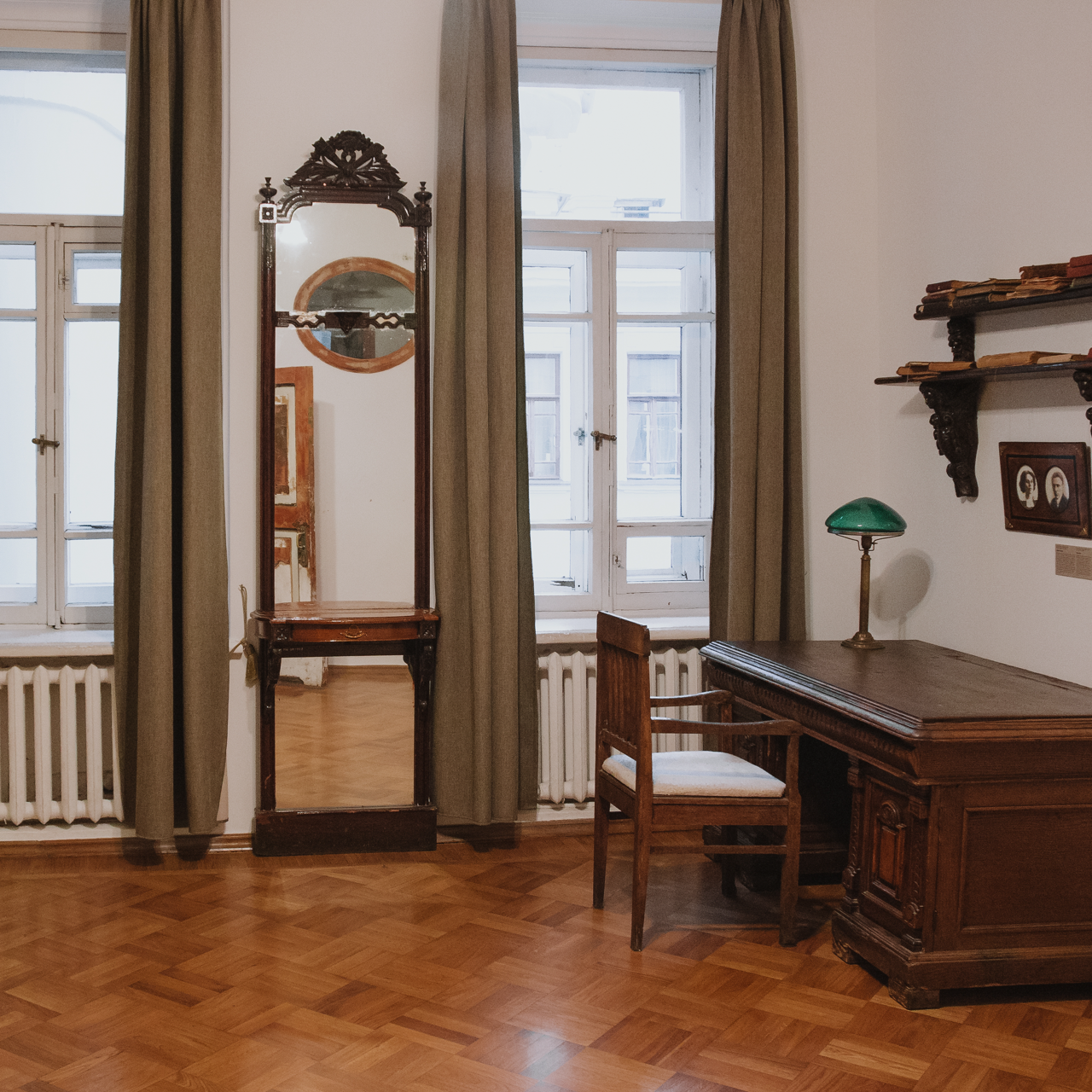
In this flat, which is most famous for being the place where the events in the novel The Master and Margarita unfold, Mikhail Afanasevich Bukgakov lived from autumn 1921 to summer 1924. In November 1924, he deregistered himself from his living quarters and left for good. After the revolution, Ilya Pigit’s flat block was nationalised and workers were settled in it. Sixteen people (including the famous Annushka) lived in flat 50 together with the writer and his wife T. Lappa. Here Bulgakov wrote his novel The White Guard and the short stories Diaboliad and The Fatal Eggs, as well as many essays and satirical pieces. The rowdy inhabitants of the communal flat tormented Bulgakov and hindered his work. Bulgakov made this telling entry in his diary in October 1923: ‘Today they started heating the flat for the first time. I spent the whole evening sealing the windows. The first night of heating was marked by the fact that the famous Annushka left the kitchen window wide open. I have positively no idea what to do with the scoundrels who live in this flat.’ The story No. 13 – Elpit-Rabkommuna House is dedicated to the very house itself, and the scandalous neighbours became literary figures. For example, the famous Annushka – who caused Berlioz’s death (The Мaster and Margarita) – actually lived in flat 50 and the characters of Shvonder (Heart of a Dog) and his accomplices were taken from real members of the worker’s commune in house 10 with whom Bulgakov had to deal with on more than one occasion. Although the writer moved in autumn 1924, the famous house remained a constant feature in his writing. The dual life of Maksudov from the late autobiographical novel Theatrical Novel (1936) – spending his days at an uninteresting job and his nights at his writing desk – was thought up by Bulgakov from his memories of the hated communal flat. Woland and his retinue became the last inhabitants of the ‘unpleasant flat’.
The novel The Master and Margarita famously begins here. This is a very popular area for strolling – once for the writer and his friends, and now for Bulgakov’s fans. From 1932 to 1994 the ponds were known as the Pionersky Ponds Historically, this area was known as Goat Marsh. In the seventeenth century, Patriarch’s settlement appeared here. Patriarch’s Ponds were originally three ponds ordered by Patriarch Ioakim in 1683-1684 to farm fish for his table. In the first half of the nineteenth century, they were filled in, leaving one decorative pond around which a square was established. Patriarch’s Ponds were one of Bulgakov’s favourite places in Moscow and he had a great number of stories connected to them. According to L.E. Belozerskaya, the writer discussed important issues at Patriarch’s Ponds (‘One especially intimate conversation in which M.A. – a closed person – was extremely open bought me over and changed my attitude on single life’).
This is the supposed place of MASSOLIT Chairman Mikhail Berlioz’s death in The Master and Margarita: ‘And right then a tram came hurtling along, turning down the newly-laid line from Ermolaevsky to Bronnaya. The tram went over Berlioz and a dark, round object was thrown out under the fence of Patriarch’s Path onto the cobbled slope. It was the severed head of Berlioz.’ “Are you looking for the turnstile, citizen?” inquired the checked type in a cracked tenor. ‘Come this way!” The precise location of the fateful turnstile remains a mystery for fans of the novel to this day. Having decided to contact the bureau of foreigners, Berlioz headed for the telephone booth on the corner of Ermolaevsky Lane and Malaya Bronnaya Street. By the time the literary man was approaching the turnstile, the tram had already turned and was moving along Bronnaya – so the turnstile was not on the corner but somewhere close further along the street. The location of the tramlines at Patriarch’s Ponds remains to be explained. We know that there was no passenger tram line here, although in numerous publications about Bulgakov and his works there is information about a temporary freight line and about an unofficial depot used to regulate the traffic on the main lines.
The bench on which Woland, Berlioz and Bezdomny had a conversation in the novel was probably located at the beginning of the path running along Malaya Bronnaya – roughly opposite house 32. ‘There, by the very exit onto Bronnaya, the same citizen who, in the sunlight, had earlier formed himself out of the thick heat stood to greet the editor.’ In The Master and Margarita, benches are places where the characters meet with dark powers on more than one occasion. Azazello sat next to Margarita in the Alexandrovsky Garden. During his conversation with Woland, the buffet manager Sokov fell from a bench. Nikolay Ivanovich shared this fate, falling from the bench by Margarita’s house after the ‘conversation’ with his witch neighbor. The on-duty agent who was smoking on a bench in the stairwell of house 302-bis was scared by Margarita and Azazello. A ‘low bench’ figured in Woland’s transformed room… In the epilogue, benches located by Patriarch’s Ponds and by Margarita’s house are mentioned again.
After the revolution, the main literary organisations of Moscow were located in the house in which A. I. Herzen was born – the All-Russian Union of Writers, the Russian Association of Proletarian Writers and others. This house is depicted in The Master and Margarita as the Griboyedov House in which the fictitious organisation MASSOLIT is based. In Bulgakov’s era, the Union of Writers and other literary organisations played an enormous role in the lives of literary people, significantly regulating their publications and therefore their livelihoods, not to mention their access to the public. Exclusion from the Union was a form of dealing with unwanted authors and voluntary exit was a strong form of protest, which few dared to carry out. In 1929, a great campaign against Evgeny Zamyatin and Boris Pilnyak was lauched after the publishing of their novels We and The Red Tree abroad. Zamyatin was excluded from the Union of Writers, his plays were taken out of theatre repertoires and he was forbidden from publishing. His name, if mentioned at all, only appeared in negative contexts. As a protest against the witch-hunt against his friend, M. Bulgakov submitted his notice on leaving the Union of Writers on 2nd October 1929. On 8th October, A. Yakovlev told Zamyatin in a letter, ‘Veresaev recommended that I leave the administration under the pretext of illness. I don’t think this is a way out. If one is to leave, then it’s as a protest. The exits from the Union – yours, Akhmatova’s, Bulgakov’s – are a moral blow to everyone’.
In the novel The Master and Margarita, the poet Ryukhin addresses his monologue to this bronze Pushkin. The monument is the work of A. Opekushin and was erected at the top of Tverskoy Boulevard in 1880. In the 1950s, it was moved to its current location on Pushkinskaya Square. Until 1937, the square was known as Strastnaya Square. The Strastnoy Monastery, established in 1654, was located here. When the centenary of Alexander Pushkin’s death was being commemorated across the country in 1937, the monastery was demolished and the square was renamed Pushkinskaya Square. Practically all spheres of Soviet culture were involved in the commemorations. Pieces were written, films made and plays and opera performances of Pushkin’s works and about the man himself were put on. Mikhail Bulgakov too wrote a biographical play about Pushkin with a co-author, Vikentiy Veresaev, in the middle of the 1930s. Although many theatres showed an interest in staging it, the play was never performed in Bulgakov’s day. Many researchers see autobiographical motifs in the drama about Pushkin. Bulgakov saw parallels with his own fate in the tragic confrontation between the poet and the authorities.
The probable place of the first meeting between the Master and Magarita
The archway of house 17 onto Tverskaya Street
- Tverskaya
- Private life
It is assumed that this is where the main characters of the novel The Master and Margarita first met: ‘She turned off Tverskaya into the side-street and looked behind her. Well, it’s Tverskaya you know? Thousands of people were walking along Tverskaya, but I give you my word, she saw only me and she did not look alarmed, but rather as if she were ill.’ Not far from here in one of the houses at the start of Bolshoy Gnezdnikovsky lane, the first meeting between Bulgakov and his third wife possibly took place. In February 1929, Bulgakov met his future third wife at a dinner party at E. Nirnzee’s house (No. 10). ‘At the table sat an interesting lady with a beautiful haircut, Elena Sergeevna Nurenberg, married name – Shilovskaya,’ remembered L. Belozerskaya, ‘she soon became my lady friend and began to come to our home often and on an inform basis’. According to Elena Bulgakova herself, the meeting with Bulgakov did not come around without some, ‘sorcery’. ‘It was a fast, usually fast, love, on my part anyway… Some fastening came loose on my sleeve… I asked him to tie it for me and he always swore that this was some kind of sorcery, that I had tied him to me for life.
Писатель Валентин Катаев вспоминал, как в редакции журнала «Красный перец» Булгаков рассказывал Маяковскому, что пишет сатирический роман (будущие «Роковые яйца») и ищет смешную фамилию для советского профессора – поэт сразу предложил «Тимирзяев», чем привел Булгакова в восторг.
Solovev’s House (possibly the inspiration for Margarita’s house)
6 Maly Rzhevsky lane
- Arbatskaya
- Prose
One theory is that S. Solovev’s house, which was decorated with a row of symbols and mythical creatures, served as the inspiration for Margarita’s house. It’s possible that the description of Margarita’s house also absorbed features of I. Nekrasov’s house standing opposite. As is the case with the Master’s house, the search for Margarita Nikolaevna’s house is a real puzzle, even for experienced researchers. At the moment, there are more than a dozen addresses for the famous Muscovite witch, some of which fit the territorial location, whereas others fit the external description. One of the most popular theories is that Margarita’s house was at 6 Maly Rzhevsky Lane in the famous house of Sergey Solovev. The house was built in 1920 in the Art Nouveau style and is now one of the most original in the capital. Solovev’s house is decorated with a multitude of images and symbols: owls and eagle owls, the four muses of the arts, Pallas Athena, the Chimera, a statue of a lion by the entrance and a bat on the post box. E. Bulgakova lived nearby in house 11.
The address where Writer’s House (Dramlit) were placed in «Master and Margarita»
12 Bolshoi Nikolopeskovsky lane
- Arbatskaya
- Prose
Check the description for «Writer’s House (Dramlit)» address.
In April 1935, Bulgakov and E. Bulgakova were amongst several hundred guests at the spring ball organised by the American ambassador to the USSR, W.C. Bullitt. It is thought that this ball became the basis for Satan's ball in The Master and Margarita. Bulgakov met Antoine de Saint-Exupéry at the reception in Spaso House in May 1935. E. Bulgakova remembered that, at first, Bulgakov wrote the scene as a small ball in Woland's bedroom, but, whilst he was ill, rewrote it and transformed the ball in the bedroom into a grandiose affair. Many famous people were present at the reception in the American embassy together with Bulgakov – from M. Tukhachevsky to V. Meyerhold. W.C. Bullitt reported with pride to Roosevelt, 'We got a thousand tulips from Helsinki, made a number of birch trees come into leaf early and at one end of the dining room we recreated a kolkhoz [collective farm] with peasants playing the accordion, dancers and all kinds of little childish things – birds, goat kids and a couple of bear cubs. E. Bulgakova added in her diary, 'In the hall with the columns people were dancing. Lights of different colours shone from the gallery. A whole flock of birds fluttered behind a net. The orchestra had been brought down from Stockholm… On the top floor they were serving shashlik. Red roses and French red wine. Downstairs it was all champagne and cigarettes.
In the famous Torgsin (which stood for All-Union Association for Trade with Foreigners), it was possible to buy scarce products and goods with hard currency in the early 1930s. In The Master and Margarita, this is where the famous scene unfolds in which the cat Behemoth gulps down entire mandarins with their peels. Bulgakov would drop in here when he managed to receive commission in currency for productions of his plays abroad. Torgsins functioned in Moscow from 1931 until 1936. E. Bulgakova described one of her visits with Bulgakov to a Torgsin in her diary when he needed a suit for a reception at an embassy: ‘Today, Mikhail and I, having first popped into see the tailor Pavel Ivanovich, went to the Torgsin. We bought good English material for eight golden rubles per metre. The salesclerk assured us it was material for dress suits. But there weren’t any starched shirts, let alone dress shirts. We bought black shoes and black silk socks’.
The Topleninovs’ house (Bulgakov’s friends). The house of the Master
9 Mansurovsky Lane
- Кропоткинская
- Prose
The rooms on the lower floor of house 9 on Mansurovsky are generally considered to be the model for the basement where the Master lived in The Мaster and Margarita. Bulgakov’s friends and acquaintances lived here in this house (the Topleninov brothers, S. Ermolinsky and M. Chimishkian), whom he regularly visited. «“Ah it was a golden age,” whispered the narrator with shining eyes, “a completely separated little flat with a sink and running water… And the fire in the stove was always glowing!”» as the Master says about his little basement flat in the novel. From the late 1920s, Bulgakov often came to house 9 on Mansurovsky Lane and stayed in a room with a stove, which was specially put aside for him. S. Topleninov’s wife, Maria Nesterenko described the house in a conversation with M. Chudakova, ‘…six or seven steps led downstairs to the entrance room, where you took you shoes and coats off. To the left was a stove and next to it, a big, white, porcelain sink… you know, most people washed in the shared kitchens and bathrooms, but we had our own basin. In the room, there were two windows and an oval table with chairs around it. It was a Russian stove, which was always stoked. It was warm and everyone said how comfortable our place was.
Anna Kekusheva’s house (possible model for Margarita’s house)
21 Ostozhenka Street
- Kropotkinskaya
- Prose
The famous architect Lev Kekushev built this miniature castle in the Art Nouveau style in 1903 for his wife. Situated two steps away from the Master’s basement and decorated with a multi-faceted turret, this house is considered one of the most likely sources of inspiration for Margarita’s house. From 1935 to 1986, Ostozhenka was known as Metrostroevskaya Street. ‘Margarita Nikolaevna and her husband occupied the entire upper floor of a beautiful house in a garden in one of the lanes near Arbat. It’s a lovely place! Anyone can see it for himself, if he cares to visit the garden. Ask me, I’ll tell you the address and show you the way – the house still stands to this day.’ The gothic style of the building and the mention of the fact that the heroine’s bedroom was in the tower of the house show that 21 Ostozhenka could have been a model for Margarita’s house. The story which occurred within the walls of this ‘castle’ is also interesting: Ekaterina Kekusheva, the daughter of the architect, defied the protests of her family and left the rich household for the Maly Theatre set designer, Sergey Topleninov. Ekaterina and Sergey frequently visited 9 Mansurovsky Lane to see Topleninov’s older brother (this house is believed to be one of the models for ‘the Master’s house’). However, house 21 is located slightly further away from Arbat and there is no garden or fence nearby as described in The Master and Margarita, which allows the search for new addresses for Margarita’s house to continue…
Philologist Nikolay Lyamin, Bulgakov’s long-time friend, lived here. Lyamin’s house was a model for house 13 in The Master and Margarita, where Ivan Bezdomny stole the paper icon and the candle on the way to the Moskva river. Until 1922, the lane was called Savelovsky and, from 1922 to 1993, Savelevsky. This building, which belonged to the Vavarinskoe Homeowner Corporation, was built in 1898 by the architect A. Ivanov. In the Soviet era, many people involved in science, culture and art lived here (A. Abrikosov, N. Koltsov, V. Shukhov and others). Bulgakov met Lyamin at the beginning of 1924 at a gathering at the writer Sergey Zayaitsky’s place. According to Belozerskaya’s memoirs, literary readings took place at Lyamin’s flat, where, aside from Bulgakov, many writers and poets, scholars and art critics, philosophers and directors gave readings (M. Morozov, A. Gabrichevsky, B. Shaposhnikov and others). In one of the two rooms that the Lyamins occupied in a communal flat was a fireplace thanks to which the Lyamins’ place became the preferred location for such literary readings. Sometimes during the readings, up to thirty packed into the room. On different occasions, Bulgakov read the entire novel, The White Guard, the plays, Zoyka’s Apartment, The Crimson Island, The Cabal of Hypocrites, and also the first edition of, The Master and Margarita. Bulgakov and Lyamin were keen chess players, and spent a lot of time playing. In 1936, after being denounced, Lyamin was dismissed from work and arrested. After three years in a prison camp, he was banned from living in Moscow and he settled in Kaluga. Despite the ban, in 1940, he secretly travelled to Moscow to bid farewell to the dying Bulgakov.
Бросившись в погоню за Воландом, Иван Бездомный (минуя несколько переулков) оказался в доме 13, где взял иконку и свечку и отправился на набережную, где и произошло ритуальное омовение. В ранней редакции романа (1928-1929 гг.) Булгаков уточнял, что Иван оказывался на набережной храма Христа Спасителя. По воспоминаниям жен писателя (Любови Евгеньевны и Елены Сергеевны), Булгаков очень любил лыжные прогулки и регулярно совершал их в компании знакомых и близких друзей: артистов МХАТа и пречистенцев. В своем дневнике Е. С. Булгакова свидетельствовала о лыжных походах мужа в сторону Новодевичьего пруда и по Москве-реке. О лыжных прогулках Булгакова у Пречистенской набережной упоминает и знакомый писателя Сергей Ермолинский.
Woland surveyed the view of Moscow from the roof of Pashkov’s House, which was built in 1784-1786, supposedly by V. Bazhenov, and is located on the corner of Znamenka and Mokhovaya. From here, the characters watch the fire at the Griboyedov House, which was started by Korovyev and Behemoth. This is where the Master and Margarita’s fate was decided. In Bulgakov’s novel, this building was described as, ‘One of the most beautiful in Moscow’. Confirming this, E. Bulgakova remembered that Pashkov’s House and its neighbourhood were one of the writer’s favourite places in the city. In Autumn 1921, Bulgakov planned to write a play about Rasputin and asked at the Rumyantsev Museum for periodicals from 1917. Whilst he was working on the materials for the production at the end of 1920s and beginning of the 1930s, Bulgakov often visited the State Library as a reader (there are library passes in the writer’s archive). In The Master and Margarita, Woland claims that he was invited to the State Library to index the works of the black magic practitioner Gerbert Avrilaksky. In one of the editions of the novel (1932-1936), Bulgakov described Pashkov’s House in detail - after the scene on the roof of the house, Woland and his retinue pass through the reading rooms and cloakroom to find themselves in the courtyard.
The garden was built around the Kremlin after the 1812 Fire of Moscow on the orders of Emperor Alexander I. The original name of the garden was the Kremlevsky Garden – the name was changed to the Alexandrovsky Garden in 1856. In The Master and Margarita, the meeting between Margarita and Azazello at which he invites the heroine to meet, ‘a completely safe foreigner’ takes place in the Alexansrovsky Garden. This is where Margarita receives the magical lotion as a gift. The Alexandrovsky Garden and its surroundings also appear in Bulgakov’s essays. In May 1923, he witnessed a demonstration against the British Lord Curzon: ‘On Okhotny Ryad, endless rows of people walked along spanning the breadth of the street. I saw how Teatralnaya Square was completely flooded with people…’ (Benefit Performance for Lord Curzon), and in January 1924, he described the thousands of workers who gave to pay their respects to Vladimir Lenin. In the essay, Forty Forties, a commercial Moscow was presented: ‘On Okhotny Ryad the signs are so large that they overbear the little shops’. Korobochka, the heroine of Bulgakov’s satirical piece, The Adventures of Chichikov, planned to open a bakery in the Moscow Manège: ‘In vain they tried to convince her that the Manège is a public building and that it can’t be bought and that you can’t open anything inside it. The stupid wench didn’t understand a thing.’ The meeting between Margarita and Azazello in Alexandrovsky Garden is the last scene that the dying Bulgakov managed to adjust. Elena Bulgakova remembered: ‘In 1940, he made some more additions to the first part. However, when we moved onto the second part, I began to read about Berlioz’s funeral. He was about to begin making corrections when he suddenly said, -“Ok, I think that’s enough”, and he didn’t ask me to read anymore.’ The editing of the novel ended on Margarita’s words, ‘So then those are litterateurs following the coffin?’