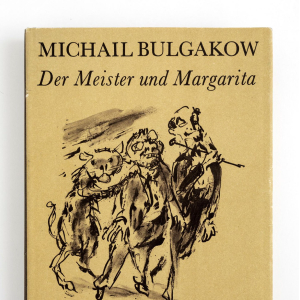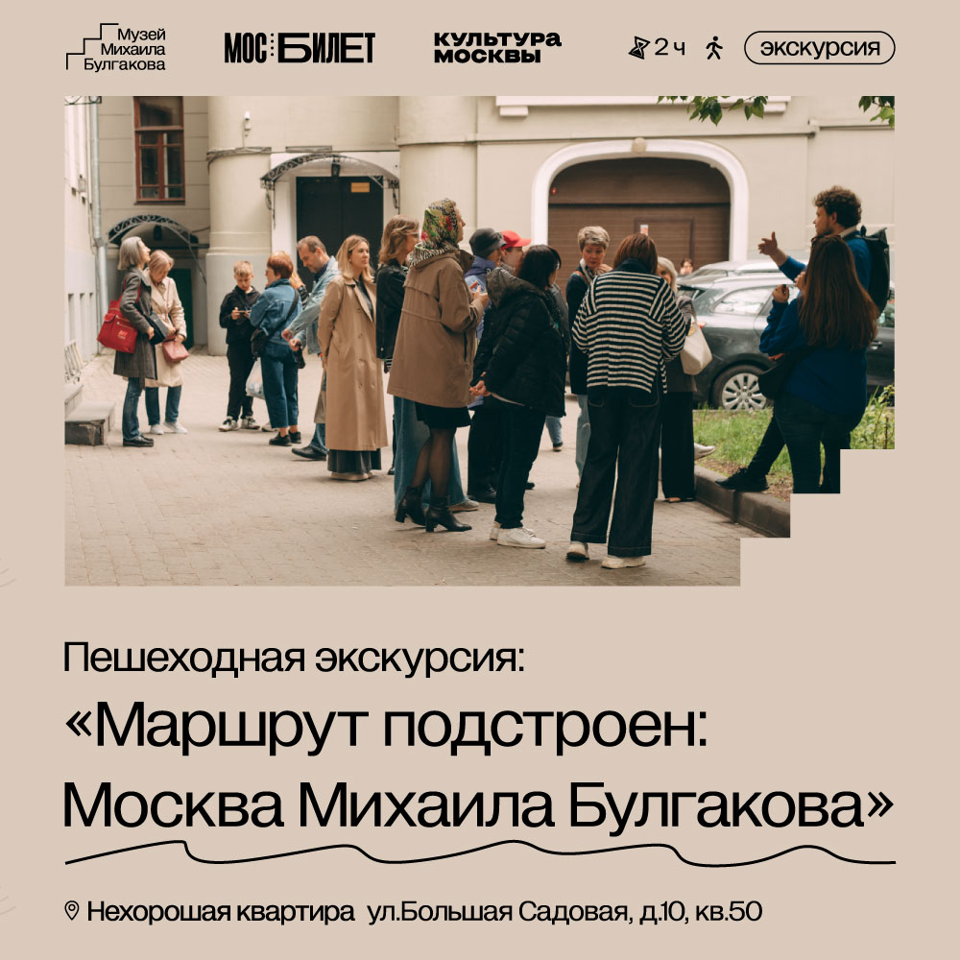


In the novel The Master and Margarita, Bulgakov accurately depicts 1920s-1930s Moscow with all her side streets, squares, houses and gardens. Even now, after dozens of years, it is possible to take the book in one’s hands and walk around practically all of the significant places in the novel. However, a number of important addresses have remained a mystery to this day. One of these is the house that inspired the house in which Margarita lived before meeting the Master — it has still not been found. In the novel, ‘Margarita Nikolaevna and her husband occupied the entire upper floor of a beautiful house in a garden on one of the lanes near Arbat’. We also know that it was a gothic house. It seems simple — follow the free and independent Margarita’s movements and spot the right house. However, it turns out that in that very lane there is and never was a gothic house. \tIn our route guide, we have gathered all the possible addresses, which could have served as the basis for the house in the novel: the Military house in which E.S. Shilovskaya lived with her husband; Solovyev’s house five minutes’ walk from Elena Sergeevna’s house; K.F. Lazarev’s block of flats not far from Mikhail Bulgakov’s final flat; and others. You can walk around each of them and choose the one which you think is the most likely to have been Margarita’s.
Route map
The route is shown on a dedicated map so you can see the full walk and jump straight to any stop.
Route stops
Open the stops in order: each page keeps its own address, context, and link back to the route.
This house, which was built by Fyodor Shekhtel and commissioned by the entrepreneur and patron Savva Timofeevich Morozov, is considered to be one of the possible models for Margarita’s house. The architecture is intriguing for its eclecticism and the predominance of English neo-gothic traits.
Amongst the popular candidates for the title of Margarita’s house is one of the most notable buildings of the Moscow Art Nouveau – the house was built by the architect Fyodor Shekhtel for the entrepreneur and collector Stepan Ryabushinsky.
Solovev’s House (possibly the inspiration for Margarita’s house)
6 Maly Rzhevsky lane
- Arbatskaya
- Prose
One theory is that S. Solovev’s house, which was decorated with a row of symbols and mythical creatures, served as the inspiration for Margarita’s house. It’s possible that the description of Margarita’s house also absorbed features of I. Nekrasov’s house standing opposite. As is the case with the Master’s house, the search for Margarita Nikolaevna’s house is a real puzzle, even for experienced researchers. At the moment, there are more than a dozen addresses for the famous Muscovite witch, some of which fit the territorial location, whereas others fit the external description. One of the most popular theories is that Margarita’s house was at 6 Maly Rzhevsky Lane in the famous house of Sergey Solovev. The house was built in 1920 in the Art Nouveau style and is now one of the most original in the capital. Solovev’s house is decorated with a multitude of images and symbols: owls and eagle owls, the four muses of the arts, Pallas Athena, the Chimera, a statue of a lion by the entrance and a bat on the post box. E. Bulgakova lived nearby in house 11.
This building, constructed in 1914, is known as the ‘Military House’. From 1929 to 1932, Elena Shilovskaya lived here on the first floor with her husband Lieutenant General Evgeny Shilosky and their sons Sergey and Evgeny. In autumn, 1932, she divorced Shilovksy and married Bulgakov. Bulgakov went to the Shilovsky’s flat on numerous occasions. Here, on the evening of 18th April 1930, he told Elena Sergeevna about his telephone call with Stalin: ‘He ran, agitated, to our flat (with Shilovsky) on Bolshoy Rzhevsky and told me the following. He lay down to sleep after lunch as usual, but the phone rang out and Lyuba called him over saying that they were calling from the Central Committee. Mikhail Afanasevich didn’t believe it and thought it was a prank…’ However, it was not a prank. A conversation took place between Stalin and Bulgakov, which would change the writer’s life. In 1932, Bulgakov was called to Shilovsky’s home. The Lieutenant General wanted to put an end to the relationship between the writer and his wife. During a tense conversation, Shilovsky whipped out his pistol to which Bulgakov answered, ‘Surely you wouldn’t shoot an unarmed man?.. Let’s have a duel!’ (according to L. Belozerskaya, Shilovsky had threatened Bulgakov with his pistol even earlier – in the spring of 1931). No duel took place – the Lieutenant General agreed to divorce Elena.
From 1927, Moscow Art Theatre artist Evgeny Kaluzhsky lived in this house. In 1932, Olga Bokshanskaya (the secretary to V. Nemirovich-Danchenko and the older sister of Bulgakov’s third wife, Elena Bulgakova) became Kaluzhsky’s second wife. Before 1936, the Kaluzhskys had lived in General-Lieutenant E. Shilovsky’s flat, and then, aside from a number of temporary addresses, settled in the house on Maly Vlasevsky Lane. On 26th June 1939, Bulgakov read The Master and Margarita in the Kaluzhskys’ house. ‘Stroev, who had become lost in chatter in Toropetskaya’s dressing room at that time, hurried to the auditorium, jumping down the stairs’ – according to E. Bulgakova, in Theatrical Novel, Kaluzhsky and his spouse, Olga Bokshanskaya, featured in the depictions of the actor Stroev and Poliksena Toropetskaya. Like the Bulgakovs, Evgeny and Olga got married in 1932. The Kaluzhskys often visited Mikhail and Elena Bulgakov on Pirogovka and Nashchokinsky Lane – together they celebrated birthdays, the new year, attended readings at home and so on. Elena wrote about one of these meetings in her diary in 1933: ‘31st December. The Kaluzhskys, Leontevs and Arendts are coming over. They’ve arrived. It was lovely. Zhenya Kaluzhsky and Leontev were dying from laughter at some unpleasant joke verses, which Mikhail composed for the new year. The poems were decent, but the rhymes should have been different. The Kaluzhskys stayed the night’. Because of its suitable location, some researchers believe the house could have been one of the models for Margarita’s house.
In tracing the path of Margarita’s flight on the broomstick in The Master and Margarita, Bulgakov experts remain certain that she flew from Maly Vlasevsky Lane. This one-storied house with a mezzanine and a semi-basement is considered a suitable candidate for the title of Margarita’s house because of its location.
This house is also counted as one of the possible models for Margarita’s house. The house’s unusual façade, which is split into three sections each of which with its own architectural theme could not have escaped Bulgakov’s attention. The left-hand section of the façade is interesting for having been created in the National Romantic style in the form of a tower. On the same Chisty Lane, in the courtyard of house 9 stood a wooden outhouse in which Bulgakov lived from November 1924 to June 1926 with his second wife L.E. Belozerskaya.
Built in the National Romantic style by the architect A.U. Zelenko, the house looks like a mediaeval castle with a peaked, tented roof. It is entirely possible that this could have been the model for Margarita’s house in Bulgakov’s famous novel and the fact that the Master’s basement lies right over the road supports this idea.
Anna Kekusheva’s house (possible model for Margarita’s house)
21 Ostozhenka Street
- Kropotkinskaya
- Prose
The famous architect Lev Kekushev built this miniature castle in the Art Nouveau style in 1903 for his wife. Situated two steps away from the Master’s basement and decorated with a multi-faceted turret, this house is considered one of the most likely sources of inspiration for Margarita’s house. From 1935 to 1986, Ostozhenka was known as Metrostroevskaya Street. ‘Margarita Nikolaevna and her husband occupied the entire upper floor of a beautiful house in a garden in one of the lanes near Arbat. It’s a lovely place! Anyone can see it for himself, if he cares to visit the garden. Ask me, I’ll tell you the address and show you the way – the house still stands to this day.’ The gothic style of the building and the mention of the fact that the heroine’s bedroom was in the tower of the house show that 21 Ostozhenka could have been a model for Margarita’s house. The story which occurred within the walls of this ‘castle’ is also interesting: Ekaterina Kekusheva, the daughter of the architect, defied the protests of her family and left the rich household for the Maly Theatre set designer, Sergey Topleninov. Ekaterina and Sergey frequently visited 9 Mansurovsky Lane to see Topleninov’s older brother (this house is believed to be one of the models for ‘the Master’s house’). However, house 21 is located slightly further away from Arbat and there is no garden or fence nearby as described in The Master and Margarita, which allows the search for new addresses for Margarita’s house to continue…
This block of flats was built in 1897 by the architect Pavel Petovich Shchektov for the entrepreneur Konstantin Fedorovich Lazarev. Bulgakov lived in the neighbouring house (3/5 Nashchokinsky Lane) from February 1934 until his death on 10th March 1940. It is believed that this building, built in a pseudo-Gothic style, could have inspired Margarita’s famous house.